
MEET AARON

HIS PHILOSOPHY
Finding What Works
I am a Sydney-based producer, multi-instrumentalist, and the founder of XMPLA Studios. Over the years, I have built a professional career in the music industry, earning recognition as a Triple J Feature Artist and winning Studios 301’s national production competition. But while creating and producing music is a huge part of my life, my other deep passion is teaching.
Navigating ADHD myself, and undergoing various types of therapy like Kinesiology, Psychology, and Neuro-Rehabilitation, I learned that achieving mental and physiological health requires consistent effort and finding what actually works.
I took this exact philosophy, combined it with 15 years of teaching and a lifetime of playing music, and built a completely new way to approach learning.
Why I Created a New Method
In traditional lessons, it is mostly following a rigid framework, such as learning to read music, playing by ear, and so on. However, many neurodivergent individuals struggle with this because they see and interpret music in a completely different way.
Some hear and focus on certain elements of music while ignoring others, while others can’t hold multiple streams of input together. Old methods work for specific people, and for the rest of us, we are left in the dark. This is exactly why I’ve implemented a new approach to teaching music.
How it Works
This method uses music and neuro-rehab skills not only to learn an instrument, but also to regulate emotions, become more grounded, and improve focus.
I have noticed the biggest difference in my day-to-day life using the sensory workouts I have developed and continue to do each day. By combining balance, eye tracking, and musical elements (like singing or drumming) into one sensory workout, it helps rewire the nervous system.
For me, this has increased my threshold and tolerance for difficult situations and emotions. It has also improved my focus, attention, and ability to handle multiple streams of input at once.
A Holistic Baseline for Focus and Learning
My approach to learning is entirely holistic. Much like the idea that we should address baseline human needs first when supporting mental health, I apply that same principle to learning and focus. Before we can expect a students mind to sit, focus, and absorb information, we have to look at the foundations of how the brain and body are operating.
In my own routine, I focus heavily on these essential foundational habits:
Sunlight, Sleep & Screen Time: Getting proper morning sunlight supports Vitamin D production and mitochondrial function. To ensure deep, restorative sleep free from disruptions, turn off your phone (or switch it to airplane mode), power down devices, and switch off nearby wall power points, especially those close to your head! A massive part of this is avoiding artificial blue light at least a couple of hours before bed; this allows your brain to produce natural melatonin, effectively winding down in sync with your body's natural circadian rhythm.
Targeted Hydration: Not just skulling tap water, but steadily sipping filtered, fluoride-free water throughout the day, adding just a pinch of Celtic salt every 1-2L for proper cellular hydration.
Toxin Reduction & Mineral Balance: Choosing organic foods whenever possible to avoid glyphosates (which are heavily sprayed on conventional crops), and understanding how things like heavy metal toxicity, essential mineral deficiencies, or cerebral folate deficiencies can drastically impact cognitive function and focus.
Play & Joy: Making time for true, uninterrupted play (something researcher Brené Brown heavily advocates for) and genuine laughter to reset the nervous system.
The Gut-Brain Connection
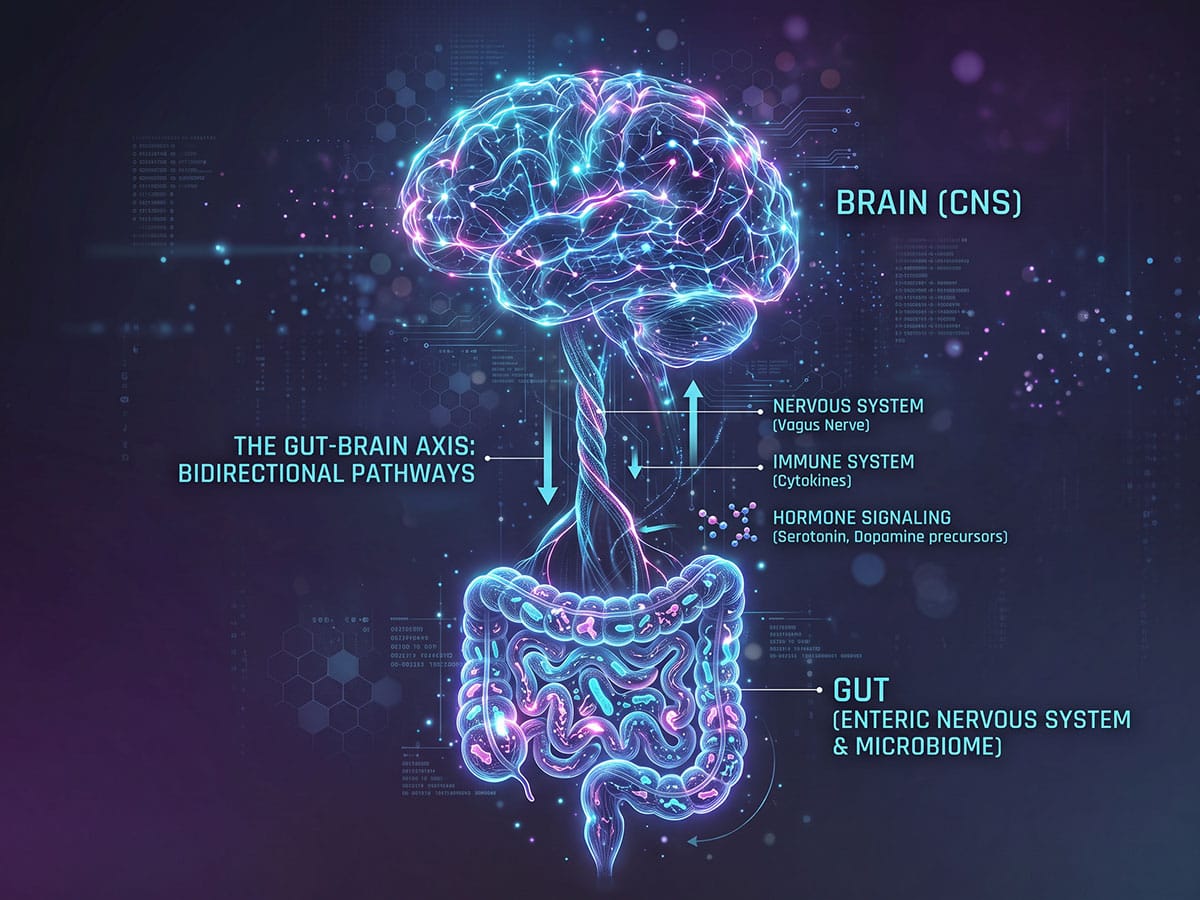
You cannot talk about fixing your nervous system and focus without talking about the gut. I have learned that the way we eat directly impacts our ability to regulate our emotions and handle stress.
Your gut and brain are in constant communication via the vagus nerve, and amazingly, 80% of that traffic runs from the gut up to the brain. In fact, over 90% of your body's serotonin is produced in your gut. When we are constantly stressed or scrolling on social media, our body enters a fight-or-flight mode that drops stomach acid, stops digestion, and halts our body's natural cleaning systems. To counter this, just taking three slow breaths with long exhales before a meal can signal to the vagus nerve that you are safe, flipping your system back into a calm "rest and digest" mode.
To keep this system functioning so that our minds stay clear and focused, I apply a few basic principles that I share with my students:
Spacing Out Meals: Your gut has an automatic cleaning wave called the migrating motor complex that pushes out leftover food and bacteria every couple of hours. Constant snacking interrupts this wave, so spacing out meals gives the digestive system time to sweep itself clean and function at its best.
Eating Whole Foods: Providing the gut with real, organic nutrients rather than highly processed foods ensures the brain gets the essential building blocks it needs to produce serotonin, stabilize moods, and maintain focus.
Mindful Eating: Taking time to sit away from screens and taking those few slow exhales before eating ensures the nervous system is in the right state to absorb what the body needs.
Bringing It Back to the Music Room
By being mindful of how physical energy and focus affect learning, we don't just force our way through a rigid drum lesson if a student arrives completely dysregulated. Instead, we might pivot to a quick physical or sensory reset, adjust the pace or content for the session to match where they're at. This approach ensures I'm supporting the whole person, because when the mind and body are actually ready to engage, the music follows naturally.
My Promise to You
My goal is simple: figure out how your brain learns best, pinpoint the exact friction points holding you back, and build up your strengths from there. No cookie-cutter lesson plans. If a standard approach isn't clicking, we switch gears. We use out-of-the-box solutions, targeted exercises, and a variety of experimental methods until we find the exact formula that unlocks your progress and keeps you moving forward.
REFERENCES
Explore the specific research on how cross-body movements, balance, and mineral deficiencies affect learning
BALANCE
The Body Can Balance the Score: Using a Somatic Self-Care Intervention to Support Well-Being and Promote Healing Explores how somatic and physical self-care practices support emotional regulation.
Vestibular Balance linked to Emotional Balance
Highlights connections between physical balance systems and mental stability.
https://neurofrontiers.org/article/a-stable-body-creates-a-stable-mind/
The Power of Bilateral Movement and Walking for Improved Health
Discusses how cross-body movements assist with nervous system grounding.
Understanding the links between vestibular and limbic systems regulating emotions
Academic study on how movement sensors in the inner ear interact with emotion centers.
DIET & HEALTH
Vitamin D in Neurological Diseases
Overview of how Vitamin D supports overall neurological health and function.
Sugar for the brain: the role of glucose in physiological and pathological brain function
Examines glucose metabolism and its impact on brain energy and focus.
Cerebral Folate Deficiency, Folate Receptor Alpha Autoantibodies and Leucovorin (Folinic Acid) Treatment in Autism Spectrum Disorders: A Systematic Review and Meta-Analysis
Systematic review on folate pathways and targeted nutrient support.
Association of Attention-Deficit/Hyperactivity Disorder and Celiac Disease: A Brief Report
Explores overlaps between gut sensitivities and attention-related traits.
Impact of Gluten-Free and Casein-Free Diet on Behavioural Outcomes and Quality of Life of Autistic Children and Adolescents: A Scoping Review
Scoping review detailing dietary elimination studies and variable outcomes.
https://pmc.ncbi.nlm.nih.gov/articles/PMC11274980/#sec7-children-11-00862
Metal Profiles in Autism Spectrum Disorders: A Crosstalk between Toxic and Essential Metals
Review examining interactions between essential minerals and heavy metal profiles.
Disclaimer: The health, nutrition, and wellness practices discussed here are based strictly on my own personal research, lived experience, and individual results. They are shared for educational and informational purposes only and do not constitute medical advice. Any decisions regarding health or lifestyle changes should be made in consultation with a qualified medical professional and through your own due diligence. If you or your child have specific medical conditions or health concerns, always consult a healthcare provider to ensure any new habit or practice is safe and suitable for your specific needs.